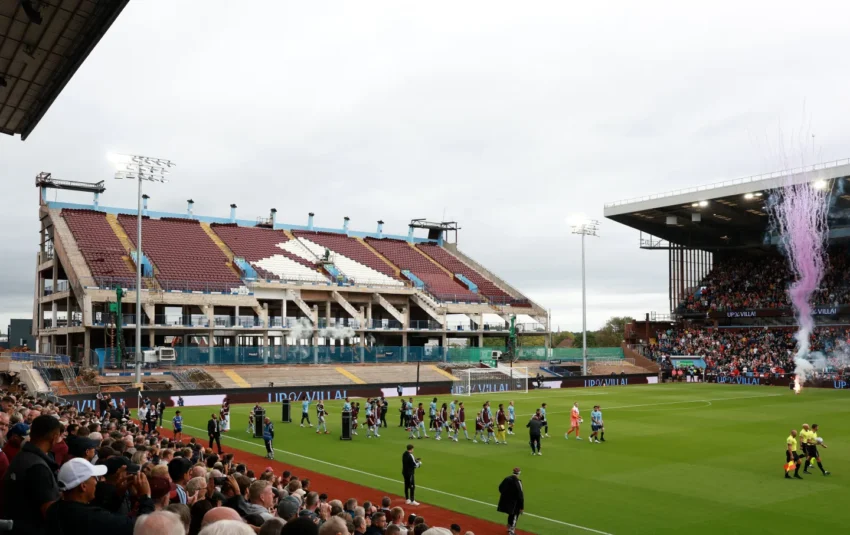
Matty Cash admits Villa Park’s £100m North Stand rebuild has left Aston Villa’s home form feeling “obviously different”
Aston Villa defender Matty Cash has openly acknowledged that the club’s ambitious £100 million redevelopment of the North Stand at Villa Park is having a tangible effect on the team’s performances at home this season. Speaking ahead of Wednesday night’s Champions League clash against Fenerbahce, which is live on talkSPORT, the Poland international stopped short of using the missing stand as an outright excuse but made clear that the atmosphere and feel of the famous old ground have changed.
Villa have yet to win a Premier League match at home in 2026-27. They lost to Arsenal and Nottingham Forest before drawing 2-2 with Brentford last weekend after leading late in the game. With the North Stand completely closed for the entire campaign, capacity has been reduced from around 43,000 to roughly 37,000, leaving one end of the stadium empty and the ground operating as a three-sided venue.
“Our home form has not been what we want it to be,” Cash admitted. “Without sounding like we’re making excuses, because we have to deal with the circumstances. Obviously for the club and the platform, it’s really good to make the stand bigger, and the stadium bigger for capacity. But it’s obviously different. I’m not going to sit here and lie and say it’s not, it is different. But as I said, the circumstances, you have to deal with it as a player, you can’t make excuses, you have to play with what’s in front of you. When it’s done, it will be amazing but obviously at the minute, it is a bit different without making excuses.”
The comments capture a careful balancing act. Cash recognises the long-term benefits of the project while refusing to hide from the short-term reality that Villa Park currently feels incomplete. The North Stand, which sits opposite the famous Holte End, has been a key part of the stadium’s character for decades. Its temporary absence removes not only several thousand supporters but also a significant portion of the noise and visual intensity that once made visiting teams uncomfortable from the first whistle.
Villa announced the full-season closure of the stand in April 2026. The works form part of a wider plan to expand capacity beyond 50,000 ahead of Euro 2028, when Villa Park is scheduled to host matches. The new North Stand is expected to hold around 12,000 spectators once complete, with further incremental improvements planned for the other three sides of the ground. Club officials have consistently framed the disruption as a necessary investment in the future, one that will generate greater matchday revenue, improve facilities for players and fans, and strengthen Villa’s ability to compete at the highest level.
Manager Unai Emery has struck a similar note. The Spaniard has described the reduced crowd as a “handicap” but has been firm that it cannot become a reason for underperformance. “Tomorrow we will be at Villa Park again with the energy we need. We have one handicap, it’s less supporters for this situation,” Emery said. “But at the beginning of the season, the club decided it, and it’s something to improve for the future – not now, but for the future. It’s not excuses. We must try to be together, and without 7,000 supporters like there normally are in Villa Park, we must push everybody, and play football. One improvement in Villa Park is to play football, better football than we played. Compete better than we compete, to be focused more than we did, to be demanding more than we did. Those improvements are very important, more than the stand.”
Emery’s insistence on collective responsibility echoes the culture he has built since taking charge. Under his leadership, Villa Park earned a reputation as one of the hardest places to visit in the Premier League and in Europe. The team went more than a year without losing at home at one stage, and their European home record in recent seasons has been exceptional: 18 wins from 20 matches across three campaigns, with only Olympiacos managing a victory and Juventus taking a draw.
Cash himself pointed to that recent history when discussing the importance of the coming week. Villa face Fenerbahce on Wednesday before hosting Norwegian side Viking in the Champions League the following week. Two home European fixtures offer a chance to rebuild confidence and atmosphere in front of their own supporters.
“It is massive,” Cash said of the upcoming matches. “Especially at home, over the last few years our home form has been amazing, not just in Europe but overall. We went on a run when we didn’t lose for more than a year. We need to get back to that because if you can be dominant at home and pick up points on the road as well, you can be really powerful. That is what we have done over the years. Brentford last weekend we wanted to win but got a draw against a good team. Tomorrow is a massive test against a good team but we need to be winning these games. That is the bar we have set for ourselves. Hopefully we can make it loud tomorrow – three stand loud! It will be good.”
The defender also highlighted Emery’s constant emphasis on making Villa Park a fortress. “He always speaks about how important it is at home to make it a real atmosphere for other teams – to not make it easy for them to play. Over the years, I think we’ve done that. The fans got alongside it, we’ve got alongside it. Coming to Villa Park is a fortress, and he’s passed that message on to us. It’s a collective thing, the fans and us, making it really difficult for teams to come and play. Being powerful at home and being hard to beat. Over the years, from start to finish – I’ve been here since the manager’s been here – we’ve always been powerful and dominant at home. That’s what we need to get back to – without speaking about the stand, with what’s in front of us.”
The practical impact of the reduced capacity is visible on matchdays. The Holte End continues to generate noise, and the remaining three sides still create a strong presence, but the empty end changes the geometry of the stadium. Sound travels differently. The visual pressure on opposing defenders when Villa attack that goal is reduced. Visiting managers have already noted the unusual feel of the ground. Brentford boss Keith Andrews, reflecting on his own experiences of three-sided stadiums as a player, described the sensation as unnatural and said it fails to generate the same atmosphere.
Yet both Cash and Emery are determined that the players themselves must drive the solution. Villa’s squad has undergone significant change over the summer, with several key departures and new arrivals needing time to settle. Injuries have also disrupted consistency. The draw with Brentford showed resilience after falling behind, but the inability to close out a lead at home remains a concern. Emery has spoken repeatedly about the need for greater focus, better structure, and higher intensity, particularly in the final third and in defensive transitions.
The wider context of the redevelopment is important. Villa’s owners have long viewed stadium expansion as essential to closing the financial gap with the traditional elite. Matchday revenue at a 43,000-capacity ground is limited compared with larger venues. Increasing capacity past 50,000, improving hospitality and commercial facilities, and positioning Villa Park as a modern venue capable of hosting major tournaments all form part of a longer-term strategy. The club has been careful to stress that the decision to close the North Stand for a full season rather than stretch the works over two campaigns was taken to minimise overall disruption and meet the Euro 2028 timeline.
For supporters, the situation is mixed. Season-ticket holders from the North Stand were relocated elsewhere in the ground, and the reduced capacity has made tickets harder to obtain for some fixtures. At the same time, many accept that the short-term sacrifice is necessary for the club’s growth. When the new stand opens, the increased atmosphere and revenue should benefit everyone connected with the club.
Wednesday night against Fenerbahce therefore carries extra weight. A first home win of the season, secured under the lights in the Champions League, would provide both points and psychological lift. Cash’s call for a “three-stand loud” atmosphere is a direct appeal to the fans who remain. History suggests Villa supporters respond when the team needs them most. The challenge for the players is to give those supporters something to roar about.
Cash’s honesty is refreshing in an era when many players default to carefully neutral answers. He did not pretend the missing stand is irrelevant, nor did he allow it to become a convenient shield. The message is clear: the stadium is different, the circumstances are not ideal, but the standards and expectations remain the same. Villa have built a reputation for making their ground a difficult place for visitors. Reclaiming that reputation, even with one stand empty, is now the priority.
As the team prepares for Fenerbahce, the focus inside the dressing room is on performance rather than environment. Emery’s insistence that better football, greater intensity and collective demand will matter more than the missing seats sets the tone. Cash’s comments reinforce it. The £100 million investment will eventually deliver a bigger, better Villa Park. Until then, the players and the remaining supporters must create the atmosphere and the results themselves. The test begins on Wednesday night.